Large Loss and Catastrophic Response in Henderson
24/7 large loss and catastrophic response in Henderson and surrounding areas. IICRC-certified, insurance billing accepted. Call (702) 845-1325.
When a loss spans multiple units, multiple floors, or multiple structures, the math changes. A single-crew response that works fine for a residential flood will fall apart on a 40,000-square-foot apartment complex, a hotel wing, or a commercial building with mixed water and fire damage. Large loss and catastrophic response is built for that scale: more technicians, more equipment, and a project structure that can hold up under the scrutiny of a large loss adjuster reviewing a seven-figure claim.
What large loss and catastrophic response actually involves
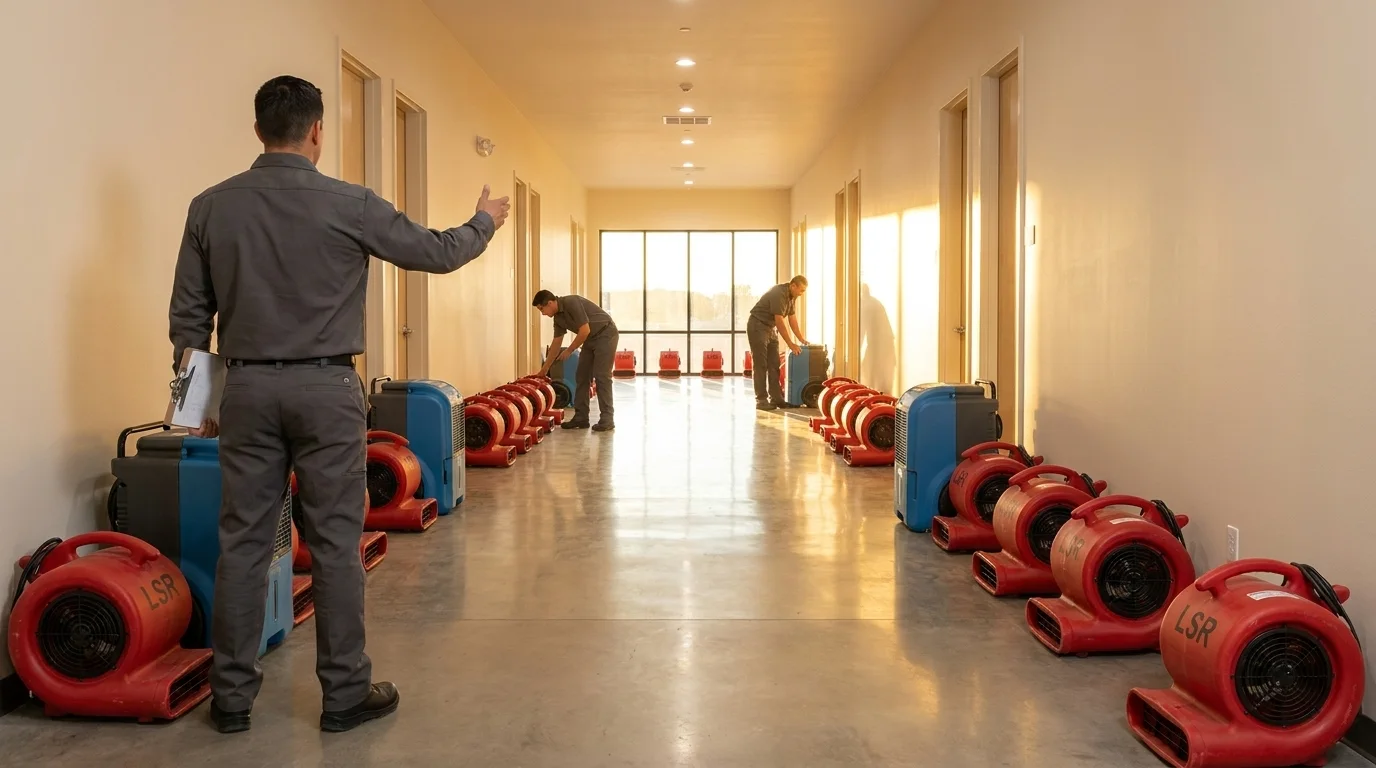
A large loss is generally defined by scope, not just dollar amount: multiple affected structures, extensive square footage, business interruption, or damage severe enough to require a dedicated project manager rather than a single site lead. Catastrophic events, wind-driven storm damage across a property complex, a sprinkler failure that floods several floors of a mid-rise, a fire that compromises common areas in a multifamily building, demand simultaneous mobilization of extraction equipment, air movers, dehumidifiers, and documentation crews across every affected unit at once, not sequentially.
The work is coordinated through a single project lead who manages subcontractors, tracks drying logs across dozens of rooms or units, and produces documentation detailed enough to support a claim that may run into the hundreds of thousands or millions of dollars. Timelines run longer than a standard residential job, sometimes weeks, because the scope includes contents handling, temporary power, and often reconstruction scheduling layered on top of mitigation.
Our process
- Rapid scope assessment and mobilization. A project lead walks the full affected area, documents damage by zone or unit, and determines crew count and equipment load before work starts, not after.
- Multi-crew deployment and equipment logistics. Extraction, containment, and drying equipment get staged simultaneously across every affected area so one wing or floor isn’t drying while another sits untouched.
- Phased mitigation with continuous documentation. Moisture readings, photos, and drying logs are tracked by zone using industry-standard estimating formats so the file holds together when it reaches a large loss adjuster.
- Ongoing coordination with property managers, adjusters, and general contractors. On a catastrophic loss, there are usually several stakeholders with different priorities; someone has to keep the schedule and the paperwork aligned across all of them.
- Handoff to reconstruction. Once drying and mitigation are verified complete, scope of work transfers to rebuild with continuity of documentation from day one through final walkthrough.
What separates a good large loss response from a bad one
The most common failure point is under-resourcing: sending a two-person crew to a job that needs eight, which stretches drying timelines and lets secondary damage (microbial growth, warped flooring, delaminating drywall) set in while equipment slowly catches up. The second is documentation that doesn’t scale. A moisture log that works for a single bathroom doesn’t work for 60 units; adjusters reviewing multi-million dollar restoration claims expect zone-by-zone readings, dated photos, and equipment placement records that can be cross-referenced against the estimate.
Good large loss and catastrophic response also means someone is actively managing the sequence of trades. Mitigation, contents handling, and reconstruction scheduling have to interlock, because a delay in one area holds up the whole project and extends the period a commercial property sits unusable. Adjusters on commercial catastrophic restoration claims are also watching for scope creep in the other direction: line items added without supporting documentation, or drying equipment left running past the point verified by moisture readings.
What does large loss and catastrophic response cost?
Costs on large loss work scale with square footage, number of affected units, and whether reconstruction is bundled into the scope. Every loss is different, and Life Savers Restoration LLC provides a written scope of work before mitigation begins so the estimate reflects the actual footprint of the damage, not a guess. Most commercial and multifamily property policies cover mitigation and reconstruction after a covered peril, though business interruption and contents coverage vary by policy and are worth confirming with the carrier early.
| Scenario | Typical range |
|---|---|
| Single-building commercial water loss, under 10,000 sq ft | $25,000 - $75,000 |
| Multi-unit residential fire with structural damage | $75,000 - $250,000 |
| Hotel or multifamily flood affecting several floors | $150,000 - $500,000 |
| Catastrophic storm damage across a multi-building complex | $250,000 - $1,000,000+ |
| High-rise fire with widespread smoke migration | $500,000 - $2,000,000+ |
Seasonal & regional considerations
The Las Vegas valley’s monsoon season brings short, intense storm cells that can overwhelm roof drainage and parking structures on large commercial properties faster than on a single-family home, turning a localized leak into a multi-unit water event within hours. Extreme summer heat also works against standard drying timelines on large jobs, since ambient heat and low humidity swings can mask moisture readings in wall cavities if monitoring isn’t frequent enough across a large footprint. Winter freeze events, while rare, have caused pipe failures across multifamily properties in the region, which is exactly the kind of multi-unit scenario large loss response is built to handle.
Service area
Life Savers Restoration LLC responds to large loss and catastrophic events throughout Henderson and the greater Las Vegas valley, including Las Vegas, Boulder City, and surrounding communities, for commercial properties, multifamily complexes, and large residential losses.
If you’re managing a property with damage across multiple units or floors, don’t wait for the scope to define itself. Call Life Savers Restoration LLC to mobilize a large loss response and get a documented scope of work started before secondary damage spreads.
Frequently Asked Questions
Does homeowners or commercial insurance cover large loss and catastrophic restoration?
What qualifies a loss as 'large loss' versus a standard residential job?
How is documentation different on a catastrophic or multi-million dollar claim?
How many crews does a catastrophic response typically require?
Does large loss response include reconstruction, or just mitigation?
Looking for the best large-loss-response company in Henderson?
Life Savers Restoration LLC provides licensed and insured large-loss-response in Henderson, NV and the surrounding area, and has served local property owners since 2019. Customers rate us 4.8 out of 5 stars across 246 Google reviews. We answer calls 24/7 — call (702) 845-1325 for immediate help.
Need large-loss-response now?
We respond 24/7 across Henderson and surrounding NV cities.
Related Coverage
- Our Restoration Services
- Contact Life Savers Restoration LLC
- Restoration Services in Blue Diamond
- Restoration Services in Boulder City
- Restoration Services in Cal-Nev-Ari
- Restoration Services in Enterprise
- Restoration Services in Goodsprings
- Restoration Services in Indian Springs
- Restoration Services in Las Vegas
- Restoration Services in Laughlin
- Restoration Services in Nellis AFB
- Restoration Services in Nelson
- Restoration Services in North Las Vegas
- Restoration Services in Paradise